English
Press release
0
Secondary theme
Civil society

EU Charter of Fundamental Rights
Highlights
-
 Report / Paper / Summary18November2021This report examines the EU’s main criminal law instrument in the field of counter-terrorism, Directive (EU) 2017/541. Specifically, it considers how the directive engages issues of fundamental rights, affecting individuals, groups and society as a whole.
 -
 Report / Paper / Summary11October2021This report proposes a framework for becoming, and functioning as, a ‘human rights city’ in the EU. It includes ‘foundations’, ‘structures’ and ‘tools’ for mayors, local administrations and grassroots organisations to reinforce fundamental rights locally. It is based on existing good practice and expert input by representatives of human rights cities in the EU, academic experts, international organisations and city networks.
 -
 Handbook / Guide / Manual22June2016Access to justice is an important element of the rule of law. It enables individuals to protect themselves against infringements of their rights, to remedy civil wrongs, to hold executive power accountable and to defend themselves in criminal proceedings. This handbook summarises the key European legal principles in the area of access to justice, focusing on civil and criminal law.
 -
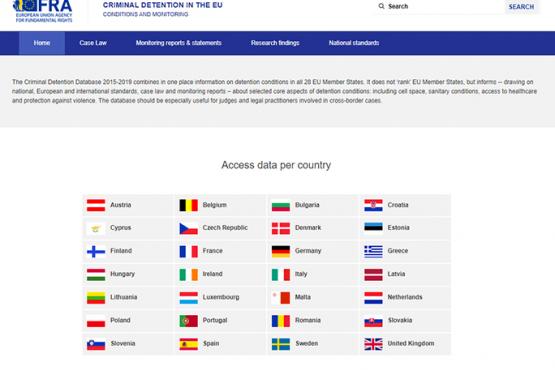 PageThe Criminal Detention Database 2015-2022 combines in one place information on detention conditions in all 27 EU Member States as well as the United Kingdom.
Highlights
-
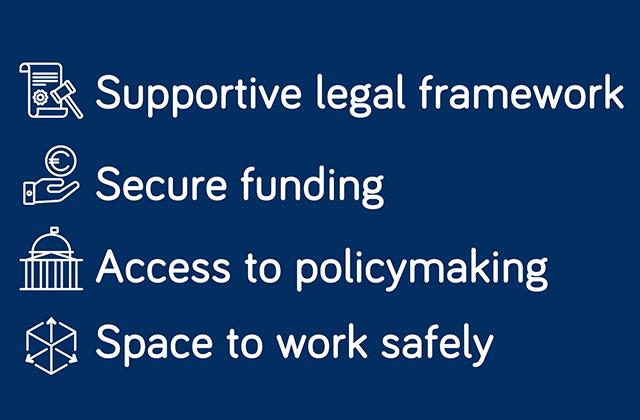
 Report / Paper / Summary18January2018Civil society organisations in the European Union play a crucial role in promoting fundamental rights, but it has become harder for them to do so – due to both legal and practical restrictions. This report looks at the different types and patterns of challenges faced by civil society organisations working on human rights in the EU.
 -
 Report / Paper / Summary22September2021Civil society organisations play a vital role in promoting fundamental rights, but they face diverse challenges across the European Union. This report presents FRA’s findings on a range of such challenges. The findings are based on research, and on two online consultations with civil society organisations, carried out in 2020.
 -
 PageThe Fundamental Rights Platform (FRP) is FRA’s channel for cooperation and information exchange with civil society organisations working on fundamental rights in the EU.
 -
 Report / Paper / Summary26November2018Civil society organisations play a critical role in democracies, and the importance of their work is widely recognised in international legal and policy documents. However, they face many obstacles when it comes to their day-to-day work. Based on the results of an online consultation with FRA’s civil society network, the Fundamental Rights Platform (FRP), in September 2018, this paper complements the January 2018 report.
Products










Multimedia
News
Events
Primary theme
Support for human rights systems and defenders
Many organisations work to defend your rights. We help their efforts with independent evidence, advice and expertise.
We support their frontline work. And we shine a light on potential risks and priority areas. Together we make your rights a reality.
EU Charter of Fundamental Rights
Highlights
-
Report / Paper / Summary18November2021This report examines the EU’s main criminal law instrument in the field of counter-terrorism, Directive (EU) 2017/541. Specifically, it considers how the directive engages issues of fundamental rights, affecting individuals, groups and society as a whole.
-
Report / Paper / Summary11October2021This report proposes a framework for becoming, and functioning as, a ‘human rights city’ in the EU. It includes ‘foundations’, ‘structures’ and ‘tools’ for mayors, local administrations and grassroots organisations to reinforce fundamental rights locally. It is based on existing good practice and expert input by representatives of human rights cities in the EU, academic experts, international organisations and city networks.
-
Handbook / Guide / Manual22June2016Access to justice is an important element of the rule of law. It enables individuals to protect themselves against infringements of their rights, to remedy civil wrongs, to hold executive power accountable and to defend themselves in criminal proceedings. This handbook summarises the key European legal principles in the area of access to justice, focusing on civil and criminal law.
-
PageThe Criminal Detention Database 2015-2022 combines in one place information on detention conditions in all 27 EU Member States as well as the United Kingdom.
Highlights
-
Report / Paper / Summary11October2021This report proposes a framework for becoming, and functioning as, a ‘human rights city’ in the EU. It includes ‘foundations’, ‘structures’ and ‘tools’ for mayors, local administrations and grassroots organisations to reinforce fundamental rights locally. It is based on existing good practice and expert input by representatives of human rights cities in the EU, academic experts, international organisations and city networks.
-
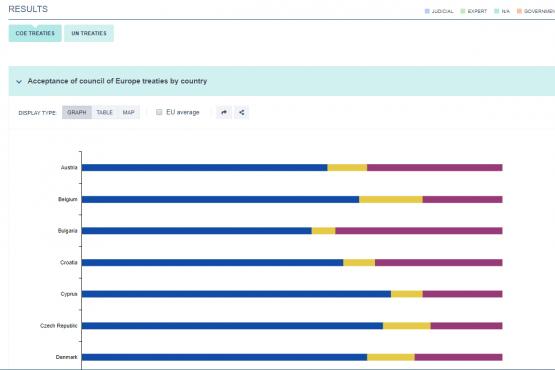 PageThe European Union Fundamental Rights Information System EFRIS is a Human Rights Gateway, bringing together data and information from existing human rights databases, and enables viewing and analysis of relevant assessments of fundamental rights in the EU.
 -
 Handbook / Guide / Manual23October2018As a very modern human rights catalogue containing many rights not found in established bills of rights, the Charter indeed looks good on paper. Those familiar with the main principles of EU law can usually quickly recite that the Charter is always binding on the EU, and binding on Member States only when they are “implementing EU law”. But what does this often-quoted language from Article 51 of the Charter actually mean?
Products





Multimedia
News
Events
Summary
On 12 January, FRA intervened at a meeting of the Council Working Party on Fundamental Rights, Citizens Rights and Free Movement of Persons (FREMP) in Brussels, which focused on the national implementation of the EU Strategy for Civil Society.
See also
Published At
2026-01-15T11:04:02
Show in News list
Yes
Archive
No