Information session on FRA’s Single Programming Document

12 February 2026


English
Press release
0
Secondary theme
Systems

National human rights systems and bodies

Highlights

  • Report / Paper / Summary
    18
    November
    2021
    This report examines the EU’s main criminal law instrument in the field of counter-terrorism, Directive (EU) 2017/541. Specifically, it considers how the directive engages issues of fundamental rights, affecting individuals, groups and society as a whole.
  • Report / Paper / Summary
    11
    October
    2021
    This report proposes a framework for becoming, and functioning as, a ‘human rights city’ in the EU. It includes ‘foundations’, ‘structures’ and ‘tools’ for mayors, local administrations and grassroots organisations to reinforce fundamental rights locally. It is based on existing good practice and expert input by representatives of human rights cities in the EU, academic experts, international organisations and city networks.
  • Handbook / Guide / Manual
    22
    June
    2016
    Access to justice is an important element of the rule of law. It enables individuals to protect themselves against infringements of their rights, to remedy civil wrongs, to hold executive power accountable and to defend themselves in criminal proceedings. This handbook summarises the key European legal principles in the area of access to justice, focusing on civil and criminal law.
  • Page
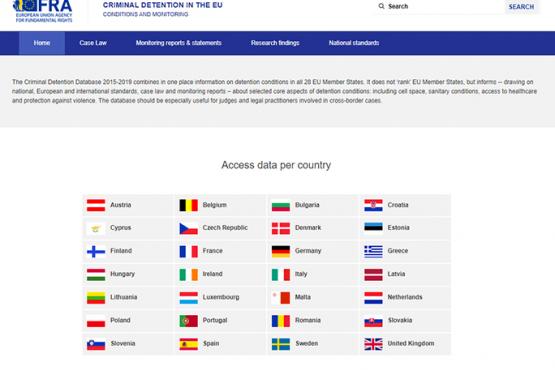
    The Criminal Detention Database 2015-2022 combines in one place information on detention conditions in all 27 EU Member States as well as the United Kingdom.

Highlights

  • Periodic updates / Series
    28
    September
    2021
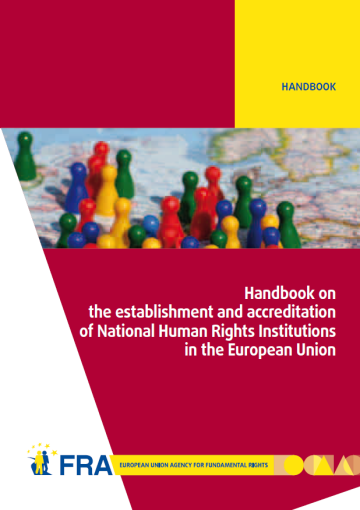
    Since September 2020, three National Human Rights Institutions (NHRIs) had a change in their accreditation status, two new institutions were created and nine have had a change in tasks covered by their mandates. Following up on the September 2020 report “Strong and effective national human rights institutions – challenges, promising practices and opportunities”, this update provides an overview of developments in the accreditation status and mandates of NHRIS in the past 12 months. The update covers the 27 EU Member States as well as three additional states within FRA’s mandate (Albania, North Macedonia and Serbia).
  • Report / Paper / Summary
    3
    September
    2020
    National Human Rights Institutions (NHRIs) are a vital part of the country-level human rights protection system. This report, published 10 years after FRA’s first in-depth study on NHRIs, looks at such bodies in the EU, as well as the Republic of North Macedonia, the Republic of Serbia, and the United Kingdom of Great Britain and Northern Ireland. It explores relevant developments, challenges to their effectiveness and ways to maximise their impact.
  • Report / Paper / Summary
    12
    November
    2019
    The Charter is most effective, and has a real impact on people’s lives, when parliaments, governments and courts at local, regional and national levels all actively apply it. The national sphere is particularly relevant. A strong fundamental rights architecture and committed national governments and parliaments are key to letting the Charter unfold its potential at this level. Civil society organisations (CSOs) and national human rights institutions (NHRIs) are also crucial given their contributions to the protection and promotion of Charter rights.
  • Video
    FRA Director Michael O’Flaherty focuses on ways to push back against challenges to our human rights system.
    Products
    29
    April
    2025
    National Human Rights Institutions (NHRIs) play an important role in providing independent human rights protection in EU Member States. Since 2020, the European Union Agency for Fundamental Rights (FRA) has been tracking the accreditation status and mandates of NHRIs across the EU. The 2025 annual update continues this work. These updates examine whether NHRIs are involved in monitoring compliance with fundamental rights in the use of EU funds, and how they use the EU Charter of Fundamental Rights when advising governments or carrying out education, training, and awareness-raising activities.
    6
    February
    2024
    The 2024 update on NHRIs accreditation status and mandates also covers their engagement in the monitoring of fundamental rights compliance in the use of EU funds at national level. Moreover, the update also shows how NHRIs make use of the EU Charter of Fundamental Rights in their work when advising government or in education, training and awareness raising activities. Since its 2020 report ‘Strong and effective national human rights institutions – challenges, promising practices and opportunities’, the European Union Agency for Fundamental Rights (FRA) has been regularly tracking the accreditation status and mandates of NHRIs.
    19
    December
    2023
    All EU funds must be spent in a way that respect fundamental rights. The EU spends billions of euros on creating jobs, economic growth, sustainable development and improving people’s lives. To prevent funds from being spent in ways that directly violate people’s fundamental rights, the EU strengthened the conditions how funds can be spent in 2021. This report looks at how the newly introduced conditions related to the EU Charter of Fundamental Rights and the United Nations Convention on the Rights of Persons with Disabilities can be upheld in practice. It analyses the potential role of national human rights institutions, ombudsperson institutions and equality bodies. These safeguards can advance compliance with fundamental rights.
    13
    December
    2022
    National Human Rights Institutions (NHRIs) continue to play a key role in upholding fundamental rights. FRA keeps track of the accreditation status and the mandates of the NHRIs. In 2022, the NHRI in Cyprus was upgraded to an ‘A-status’ institution. In addition, the mandates of six NHRIs changed to include child protection or the protection of LGBTI people.
    29
    June
    2022
    Since September 2021, two National Human Rights Institutions (NHRIs) had a change in their accreditation status, one applied for accreditation and five have had a change in tasks covered by their mandates. This new 2022 update provides an overview of developments in the accreditation status and mandates of NHRIs from September 2021 to May 2022. It is a follow up of FRA’s 2020 report on ‘Strong and effective national human rights institutions – challenges, promising practices and opportunities’ and the September 2021 update. It covers the 27 EU Member States and three candidate countries (Albania, North Macedonia and Serbia).
    28
    September
    2021
    Since September 2020, three National Human Rights Institutions (NHRIs) had a change in their accreditation status, two new institutions were created and nine have had a change in tasks covered by their mandates. Following up on the September 2020 report “Strong and effective national human rights institutions – challenges, promising practices and opportunities”, this update provides an overview of developments in the accreditation status and mandates of NHRIS in the past 12 months. The update covers the 27 EU Member States as well as three additional states within FRA’s mandate (Albania, North Macedonia and Serbia).
    21
    January
    2021
    All language versions now available
    16 April 2021
    National Human Rights Institutions (NHRIs) are a vital part of the country-level human rights protection system. By raising awareness, providing advice, monitoring and holding authorities to account, they have a central role in navigating the great human rights challenges of our day – tackling both persistent concerns like discrimination and inequality, and novel issues such as the rights implications of artificial intelligence and of the COVID-19 pandemic.
    This video statement by FRA Director Michael O’Flaherty was recorded for the Annual Conference of the Geneva Human Rights Platform: ”Connectivity between regional and global human rights mechanisms”.
    3
    September
    2020
    Summary version now available
    21 January 2021
    National Human Rights Institutions (NHRIs) are a vital part of the country-level human rights protection system. This report, published 10 years after FRA’s first in-depth study on NHRIs, looks at such bodies in the EU, as well as the Republic of North Macedonia, the Republic of Serbia, and the United Kingdom of Great Britain and Northern Ireland. It explores relevant developments, challenges to their effectiveness and ways to maximise their impact.
    Michael O’Flaherty introduces the July edition of FRA’s bulletin on the impact for fundamental rights of Covid-19. In this vlog he talks about the important role that people play who are engaged with the promotion and the protection of human rights in these times.
    The July edition of the COVID-19 bulletin will be available from 30 July.
    12
    November
    2019
    The Charter is most effective, and has a real impact on people’s lives, when parliaments, governments and courts at local, regional and national levels all actively apply it. The national sphere is particularly relevant. A strong fundamental rights architecture and committed national governments and parliaments are key to letting the Charter unfold its potential at this level. Civil society organisations (CSOs) and national human rights institutions (NHRIs) are also crucial given their contributions to the protection and promotion of Charter rights.
    FRA Director Michael O’Flaherty focuses on ways to push back against challenges to our human rights system.
    20
    May
    2016
    This opinion addresses the designation and operation of a framework established under Article 33 (2) of the CRPD at EU level (EU Framework). It aims to clarify the requirements of an EU Framework in light of the monitoring practice and jurisprudence of the CRPD Committee and – with regard to the concept of independence –the Committee interpreting the Paris Principles on the establishment of National Human Rights Institutions (NHRIs).
    1
    October
    2013
    Drawing on evidence gathered in its surveys and reports, FRA submits a set of opinions aimed at improving the protection against discrimination. These could be taken into account in the implementation and the eventual reform of the EU legal framework on the protection against discrimination.
    15
    October
    2012
    National Human Rights Institutions (NHRIs) protect and promote human rights at the national level, tackling systemic problems and raising fundamental rights awareness. To equip NHRIs to perform their role well, they should have, among other qualities, independence, powers and a broad mandate, in accordance with the so-called ‘Paris Principles’ which were adopted by the United Nations General Assembly in 1993 and set forth the primary minimum standards for an effective NHRI.
    7
    May
    2010
    The EU plays a pioneering role in the protection of personal data. The Charter of Fundamental Rights of the EU enshrines the right to data protection as an autonomous fundamental right. Despite the underlying importance and centrality of the right to data protection in the EU, many deficiencies are present in the data protection system. This study on data protection identifies deficiencies in the EU Member States.
    7
    May
    2010
    EU-MIDIS “Data in Focus” report 3 focuses on respondents’ knowledge about their rights in the field of non-discrimination, including knowledge about Equality Bodies in Member States. This Data In Focus report on ‘Rights Awareness and equality bodies’ relates to Article 21, on ‘non-discrimination’, as enrshrined in the Charter of Fundamental Rights of the European Union.
    7
    May
    2010
    Human rights are first and foremost to be addressed at the national level. National human rights institutions (NHRIs) play an important role in the human rights architecture at the national level. This report by the European Union Agency for Fundamental Rights (FRA), is intended to identify gaps and concerns in the fundamental rights architecture in the European Union.
    Primary theme
    Systems

    Support for human rights systems and defenders

    Many organisations work to defend your rights. We help their efforts with independent evidence, advice and expertise.

    We support their frontline work. And we shine a light on potential risks and priority areas. Together we make your rights a reality.

    Highlights

    • Report / Paper / Summary
      18
      November
      2021
      This report examines the EU’s main criminal law instrument in the field of counter-terrorism, Directive (EU) 2017/541. Specifically, it considers how the directive engages issues of fundamental rights, affecting individuals, groups and society as a whole.
    • Report / Paper / Summary
      11
      October
      2021
      This report proposes a framework for becoming, and functioning as, a ‘human rights city’ in the EU. It includes ‘foundations’, ‘structures’ and ‘tools’ for mayors, local administrations and grassroots organisations to reinforce fundamental rights locally. It is based on existing good practice and expert input by representatives of human rights cities in the EU, academic experts, international organisations and city networks.
    • Handbook / Guide / Manual
      22
      June
      2016
      Access to justice is an important element of the rule of law. It enables individuals to protect themselves against infringements of their rights, to remedy civil wrongs, to hold executive power accountable and to defend themselves in criminal proceedings. This handbook summarises the key European legal principles in the area of access to justice, focusing on civil and criminal law.
    • Page
      The Criminal Detention Database 2015-2022 combines in one place information on detention conditions in all 27 EU Member States as well as the United Kingdom.

    Highlights

    • Report / Paper / Summary
      11
      October
      2021
      This report proposes a framework for becoming, and functioning as, a ‘human rights city’ in the EU. It includes ‘foundations’, ‘structures’ and ‘tools’ for mayors, local administrations and grassroots organisations to reinforce fundamental rights locally. It is based on existing good practice and expert input by representatives of human rights cities in the EU, academic experts, international organisations and city networks.
    • Page
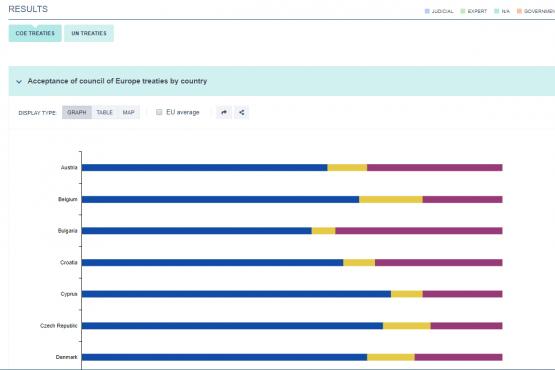
      The European Union Fundamental Rights Information System EFRIS is a Human Rights Gateway, bringing together data and information from existing human rights databases, and enables viewing and analysis of relevant assessments of fundamental rights in the EU.
    • Handbook / Guide / Manual
      23
      October
      2018
      As a very modern human rights catalogue containing many rights not found in established bills of rights, the Charter indeed looks good on paper. Those familiar with the main principles of EU law can usually quickly recite that the Charter is always binding on the EU, and binding on Member States only when they are “implementing EU law”. But what does this often-quoted language from Article 51 of the Charter actually mean?
      Products
      The Fundamental Rights Report 2025 provides a comprehensive overview of the state of fundamental rights in the European Union, highlighting major developments and trends in 2024. This video provides an insight into the issues covered by this year’s report.
      12
      December
      2025
      As the EU prepares to join the European Convention on Human Rights (ECHR), this report outlines the main changes that accession would bring, offering an overview of the legal and operational implications. Presented in a Q&A format, it provides answers to 19 key questions for legal professionals and a broader audience. It describes the steps needed to conclude accession, the expected benefits for protecting rights, and some of the challenges that may come up. This legal analysis contributes to the current discussions on EU accession.
      8
      December
      2025
      This report examines how human rights impact assessments (HRIAs) are built into lawmaking across the EU and its Member States. It highlights that, although progress has been made, the use of HRIAs remains uneven and often superficial. In many EU countries, the EU Charter of Fundamental Rights is frequently overlooked. The report identifies insufficient consultation with external experts, limited stakeholder participation and a lack of evaluation once laws are in force. To address these gaps, it offers practical recommendations for more systematic, inclusive and evidence-based HRIAs that strengthen human rights protection and ensure better, more accountable legislation throughout the EU.
      10
      June
      2025
      This publication is an excerpt from the Fundamental Rights Report 2025, the annual report of the European Union Agency for Fundamental Rights (FRA). It presents selected critical developments in fundamental rights in 2024, as well as the key findings and FRA opinions from the report’s chapters.
      10
      June
      2025
      The Fundamental Rights Report 2025 is the annual report of the European Union Agency for Fundamental Rights (FRA). It provides an overview of the state of fundamental rights in the EU and highlights selected critical developments and trends in 2024. The report covers issues such as inclusive elections, gender-based violence, and the implementation of the EU Charter of Fundamental Rights. It presents FRA’s opinions on these developments, setting out the actions that the EU and Member States should take. This annual publication is a valuable resource for those seeking to stay informed about the EU’s shifting landscape of fundamental rights.
      29
      April
      2025
      National Human Rights Institutions (NHRIs) play an important role in providing independent human rights protection in EU Member States. Since 2020, the European Union Agency for Fundamental Rights (FRA) has been tracking the accreditation status and mandates of NHRIs across the EU. The 2025 annual update continues this work. These updates examine whether NHRIs are involved in monitoring compliance with fundamental rights in the use of EU funds, and how they use the EU Charter of Fundamental Rights when advising governments or carrying out education, training, and awareness-raising activities.
      This FRF theme examines key challenges such as tackling disinformation, widening participation, protecting protests, sustaining civil society, ensuring political transparency, safeguarding institutions, and resisting the erosion of fundamental rights. Notable speakers include Emily O’Reilly, former European Ombudsman, Didier Reynders, former EU Commissioner for Justice, Alma Zadić, Austria’s former Federal Minister of Justice, and Lilian Thuram, President of the Lilian Thuram Foundation – Education against racism, among others.
      The Fundamental Rights Forum (FRF) is a unique space for dialogue, bringing together diverse voices to tackle Europe’s most pressing human rights challenges. By uniting thinkers, creators and decision makers, the Forum sparks fresh ideas and solutions for a more just future.
      5
      June
      2024
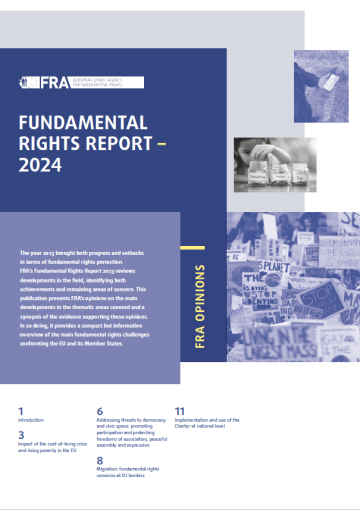
      FRA’s Fundamental Rights Report 2024 analyses the year’s developments in fundamental rights. It focuses on the most pressing fundamental rights concerns facing Europe in 2023: the cost-of-living crisis, rights concerns at the EU’s external borders and migration, and threats to democracy. Re-structured, this year’s new approach is a shorter and sharper analysis. It also presents FRA’s opinions on these developments, including a summary of the evidence supporting these opinions.
      5
      June
      2024
      The year 2023 brought both progress and setbacks in terms of fundamental rights protection. FRA’s Fundamental Rights Report 2023 reviews developments in the field, identifying both achievements and remaining areas of concern. This publication presents FRA’s opinions on the main developments in the thematic areas covered and a synopsis of the evidence supporting these opinions. In so doing, it provides a compact but informative overview of the main fundamental rights challenges confronting the EU and its Member States.
      Highlights from the Fundamental Rights Forum 2024 that took place in Vienna on 11-12 March.
      6
      February
      2024
      The 2024 update on NHRIs accreditation status and mandates also covers their engagement in the monitoring of fundamental rights compliance in the use of EU funds at national level. Moreover, the update also shows how NHRIs make use of the EU Charter of Fundamental Rights in their work when advising government or in education, training and awareness raising activities. Since its 2020 report ‘Strong and effective national human rights institutions – challenges, promising practices and opportunities’, the European Union Agency for Fundamental Rights (FRA) has been regularly tracking the accreditation status and mandates of NHRIs.
      19
      December
      2023
      All EU funds must be spent in a way that respect fundamental rights. The EU spends billions of euros on creating jobs, economic growth, sustainable development and improving people’s lives. To prevent funds from being spent in ways that directly violate people’s fundamental rights, the EU strengthened the conditions how funds can be spent in 2021. This report looks at how the newly introduced conditions related to the EU Charter of Fundamental Rights and the United Nations Convention on the Rights of Persons with Disabilities can be upheld in practice. It analyses the potential role of national human rights institutions, ombudsperson institutions and equality bodies. These safeguards can advance compliance with fundamental rights.
      20
      October
      2023
      FRA’s strategic priorities and objectives are based on the agency’s role and mission as defined in its amended founding regulation. They build on FRA’s 2018–2022 strategy as well as how it performed, its experience and its vision. Their design takes into account future fundamental rights challenges facing Europe, the agency’s mandate, the broader operational context and the resources available.
      18
      October
      2023
      Civil society organisations struggle to maintain an environment safe from threats and attacks. FRA’s sixth annual update on civic space explores the challenges for organisations across the EU. While there has been significant development since FRA began monitoring the situation in 2018, civil society organisations remain under immense pressure. Abusive lawsuits and attacks against those involved in migrant search and rescue at sea are just some of the challenges identified. This report presents ways forward to protect civil society and human rights.
      11
      July
      2023
      Across the world, human rights defenders protect and uphold human rights in some of the most challenging situations. In some countries they face worrying levels of threats and attacks, intimidation and harassment. This report outlines how human rights defenders can enter and stay in the EU when they need protection. It suggests how EU institutions and Member States could use the flexibility in existing legal provisions and provide shelter for defenders who seek protection.
      8
      June
      2023
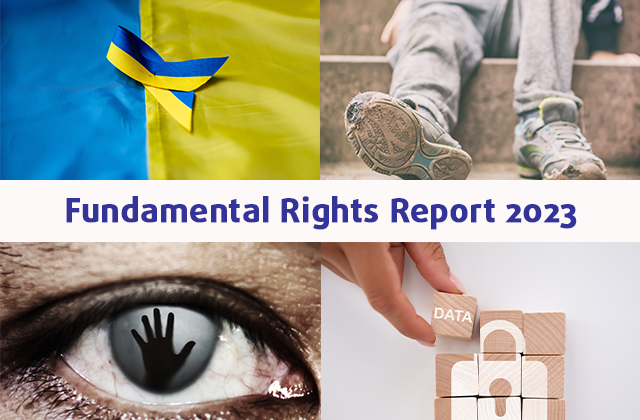
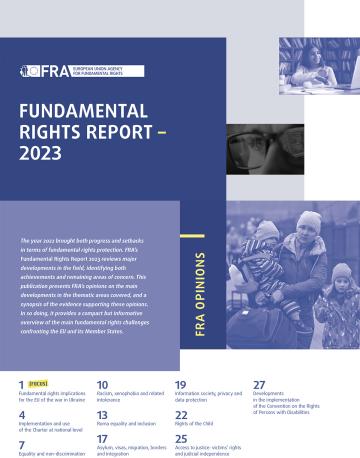
      FRA’s Fundamental Rights Report 2023 reviews major developments in the field in 2022, identifying both achievements and areas of concern. It also presents FRA’s opinions on these developments, including a synopsis of the evidence supporting these opinions.
      8
      June
      2023
      The year 2022 brought both progress and setbacks in terms of fundamental rights protection. FRA’s Fundamental Rights Report 2023 reviews major developments in the field, identifying both achievements and remaining areas of concern. This publication presents FRA’s opinions on the main developments in the thematic areas covered, and a synopsis of the evidence supporting these opinions.
      2
      February
      2023
      Many cities throughout the European Union hosted people fleeing Russia’s war of aggression against Ukraine. The EU currently faces the largest displacement of people in Europe since World War II. Since February 2022, over seven million people came to the EU. The arrival of such large numbers of people thrust cities and local governments to the forefront of the EU and its Member States’ relief work. This short publication provides a snapshot of cities’ initiatives to address this humanitarian crisis.
      13
      December
      2022
      National Human Rights Institutions (NHRIs) continue to play a key role in upholding fundamental rights. FRA keeps track of the accreditation status and the mandates of the NHRIs. In 2022, the NHRI in Cyprus was upgraded to an ‘A-status’ institution. In addition, the mandates of six NHRIs changed to include child protection or the protection of LGBTI people.
      Summary
      FRA held an information session for National Liaison Officers on the FRA Draft Single Programming Document (SPD) 2027-2029 and the related annual consultation process designed to gather opinions from Member States.
      See also
      Member States of the EU
      Published At
      2026-02-12T10:04:01
      Show in News list
      Yes
      Action buttons
      Archive
      No