Remote biometric identification in policing: public security benefits depend on robust fundamental rights safeguards

30 September 2026


English
Press release
1
Secondary theme
Data

Artificial intelligence and big data

    Products

    Publications and Data

    Displaying results 1 – 10 of 13
    Report / Paper / Summary
    30
    September
    2026
    Today, a single camera scan from a distance can identify one person in a crowd. Law enforcement authorities in a growing number of EU Member States use or are considering using this AI-driven technique, known as remote biometric identification. While it can support public security and protect people from crime, it also poses serious risks to fundamental rights. FRA’s report draws on legal analysis, interviews with law enforcement practitioners and other experts, observations of police work and a public survey across selected EU Member States. FRA points to the need for a comprehensive legal basis for RBI use for law enforcement, including defined purposes, limits on identifying participants in peaceful assemblies or political gatherings, independent oversight and fundamental rights impact assessments, all of which should be in place before RBI is deployed.
    Fundamental Rights Report
    11
    June
    2026
    The Fundamental Rights Report: Challenges and Achievements in 2025 is FRA’s flagship annual publication. It provides an overview of the state of fundamental rights in the EU and highlights selected critical developments from 2025. This year, it focuses on four areas: rights protection in a rapidly changing digital environment; the housing crisis and rising homelessness rates; employment challenges for people from non-EU countries; and the implementation of the EU Charter of Fundamental Rights. The publication is a valuable resource for those seeking to stay informed about the EU’s shifting landscape of fundamental rights.
    Report / Paper / Summary
    27
    March
    2026
    This publication presents findings from an EU-wide survey on public attitudes to children’s use of social media. It presents people’s key concerns and their views on the minimum age limits for accessing social media platforms. The survey draws on the views of both teenagers and adults – those most directly affected. The findings offer a useful evidence base for policy discussions on social media age restrictions in the EU.
    Report / Paper / Summary
    4
    December
    2025
    Artificial Intelligence comes with both benefits and risks. Safe AI use that accounts for fundamental rights is thus crucial. While the 2024 EU AI Act was a milestone in this regard, its broad definitions regarding AI systems and high-risk AI could introduce loopholes for fundamental rights compliance. This report offers an empirical basis for much-needed practical guidance on the Act’s implementation. Based on interviews with AI developers, sellers, and users, FRA addresses challenges of its use in critical domains, like asylum, education, and employment. Our findings help guide next steps in realising the AI Act’s potential to ensure responsible innovation.
    Report / Paper / Summary
    8
    December
    2022
    Artificial intelligence is everywhere and affects everyone – from deciding what content people see on their social media feeds to determining who will receive state benefits. AI technologies are typically based on algorithms that make predictions to support or even fully automate decision-making.
    Report / Paper / Summary
    29
    January
    2021
    All language versions now available
    26 July 2021
    FRA’s report on artificial intelligence and fundamental rights presents concrete examples of how companies and public administrations in the EU are using, or trying to use, AI. This summary presents the main insights from the report. These can inform EU and national policymaking efforts to regulate the use of AI tools in compliance with human and fundamental rights.
    Infographic
    Report / Paper / Summary
    14
    December
    2020
    Slovenian version now available
    20 December 2024
    Artificial intelligence (AI) already plays a role in deciding what unemployment benefits someone gets, where a burglary is likely to take place, whether someone is at risk of cancer, or who sees that catchy advertisement for low mortgage rates. Its use keeps growing, presenting seemingly endless possibilities. But we need to make sure to fully uphold fundamental rights standards when using AI. This report presents concrete examples of how companies and public administrations in the EU are using, or trying to use, AI. It focuses on four core areas – social benefits, predictive policing, health services and targeted advertising.
    Report / Paper / Summary
    27
    November
    2019
    French and German versions now available
    01 March 2022
    Facial recognition technology (FRT) makes it possible to compare digital facial images to determine whether they are of the same person. Comparing footage obtained from video cameras (CCTV) with images in databases is referred to as ‘live facial recognition technology’. Examples of national law enforcement authorities in the EU using such technology are sparse – but several are testing its potential. This paper therefore looks at the fundamental rights implications of relying on live FRT, focusing on its use for law enforcement and border-management purposes.

    Multimedia

    Displaying results 1 – 10 of 13

    News

    Displaying results 1 – 10 of 75

    Events

    Displaying results 1 – 10 of 30
    Justice

    Security

      Products

      Publications and Data
      Displaying results 1 – 10 of 21
      Report / Paper / Summary
      22
      January
      2026
      Online terrorist content is a threat to fundamental rights, rule of law and democracy. EU measures to tackle such content aim to prevent terrorism while upholding these values. FRA’s report looks at how online terrorist content is detected and removed under EU legislation. It highlights challenges in interpreting rules, risks of over-removal and potential impacts on freedom of expression. It finds that moderation practices by authorities and platforms can disproportionately affect certain groups, such as Muslims and Arabic speakers, while far-right content often receives less scrutiny. The findings, based on research and expert interviews with those addressing online terrorist content, offer ways to improve transparency in content moderation and to better balance public security and fundamental rights, contributing to wider debates on regulating online content responsibly.
      Report / Paper / Summary
      28
      September
      2022
      Acts of terrorism represent a serious threat to the lives and safety of people, and a profound security challenge for states. At the same time, counter-terrorism legislation, policies and other measures can entail, directly or indirectly, serious limitations to fundamental rights, and can adversely affect individuals, groups and society as a whole. This summary presents FRA’s main findings from its report on Directive (EU) 2017/541 on combating terrorism, the main criminal law instrument at EU level in the field of counter-terrorism.
      Report / Paper / Summary
      18
      November
      2021
      This report examines the EU’s main criminal law instrument in the field of counter-terrorism, Directive (EU) 2017/541. Specifically, it considers how the directive engages issues of fundamental rights, affecting individuals, groups and society as a whole.
      Report / Paper / Summary
      25
      May
      2021
      This paper presents statistical survey data for the EU on how often people are stopped by the police, in what kind of situations they are stopped, the action taken by the police during stops, and views on whether or not the police acted respectfully.
      Report / Paper / Summary
      22
      July
      2020
      This paper presents people’s concerns and experiences relating to security. It covers worry about crime, including terrorism and online fraud; experience of online fraud; experience of cyberharassment; and concern about illegal access to data.
      Report / Paper / Summary
      8
      March
      2019
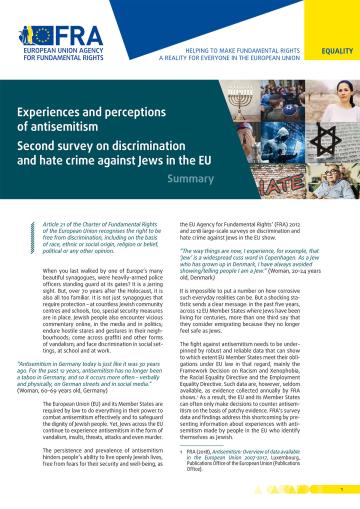
      This summary outlines the main findings of FRA’s second survey on Jewish people’s experiences with hate crime, discrimination and antisemitism in the European Union – the biggest survey of Jewish people ever conducted worldwide.
      Opinion / Position Paper
      20
      February
      2019
      This Opinion aims to inform the European Parliament’s position on the legislative proposal for a Regulation on preventing the dissemination of terrorist content online, presented by the European Commission on 12 September 2018.
      Report / Paper / Summary
      10
      December
      2018
      This report outlines the main findings of FRA’s second survey on Jewish people’s experiences with hate crime, discrimination and antisemitism in the European Union – the biggest survey of Jewish people ever conducted worldwide. Covering 12 EU Member States, the survey reached almost 16,500 individuals who identify as being Jewish. It follows up on the agency’s first survey, conducted in seven countries in 2012.
      Handbook / Guide / Manual
      5
      December
      2018
      Last versions available are EL and NL
      11 March 2021
      This guide explains what profiling is, the legal frameworks that regulate it, and why conducting profiling lawfully is both necessary to comply with fundamental rights and crucial for effective policing and border management. The guide also provides practical guidance on how to avoid unlawful profiling in police and border management operations.

      Multimedia

      Displaying results 1 – 6 of 6

      News

      Displaying results 1 – 10 of 17

      Events

      Displaying results 1 – 8 of 8
      Primary theme
      Data

      Data protection, privacy and new technologies

      More of our everyday lives are online — both at work and home. Meanwhile, terror attacks intensify calls for more surveillance. Concerns grow over the safety of our privacy and personal data.

      FRA helps lawmakers and practitioners protect your rights in a connected world.

        Products

        Publications and Data

        Displaying results 1 – 10 of 103
        Report / Paper / Summary
        30
        September
        2026
        Today, a single camera scan from a distance can identify one person in a crowd. Law enforcement authorities in a growing number of EU Member States use or are considering using this AI-driven technique, known as remote biometric identification. While it can support public security and protect people from crime, it also poses serious risks to fundamental rights. FRA’s report draws on legal analysis, interviews with law enforcement practitioners and other experts, observations of police work and a public survey across selected EU Member States. FRA points to the need for a comprehensive legal basis for RBI use for law enforcement, including defined purposes, limits on identifying participants in peaceful assemblies or political gatherings, independent oversight and fundamental rights impact assessments, all of which should be in place before RBI is deployed.
        Report / Paper / Summary
        29
        May
        2026
        Online fraud represents a major criminal threat, affecting a growing number of people across the EU. This report presents findings from an EU-wide Eurobarometer survey of 26 453 respondents, focusing on responses to survey questions developed by FRA. It explores the prevalence of online fraud, who is most at risk, and which schemes people are most likely to fall victim to. It also looks at the reporting rate to the police and contact with other services, and at the impact on victims.
        Report / Paper / Summary
        11
        May
        2026
        The ability to communicate freely and privately online is protected under Article 7 of the EU Charter; it is a crucial enabler of other fundamental rights, particularly as the world becomes increasingly digital. This paper presents results from an EU-wide survey about people’s views on encryption of their private online communication. It looks, for example, at concern regarding access by outside actors to information shared when using private messaging applications. The results indicate that people highly value encryption and at the same time have concerns about online communications being accessed without their knowledge or permission. It provides a timely evidence base to shape policy discussions on internal security and digital privacy.
        Report / Paper / Summary
        22
        January
        2026
        Online terrorist content is a threat to fundamental rights, rule of law and democracy. EU measures to tackle such content aim to prevent terrorism while upholding these values. FRA’s report looks at how online terrorist content is detected and removed under EU legislation. It highlights challenges in interpreting rules, risks of over-removal and potential impacts on freedom of expression. It finds that moderation practices by authorities and platforms can disproportionately affect certain groups, such as Muslims and Arabic speakers, while far-right content often receives less scrutiny. The findings, based on research and expert interviews with those addressing online terrorist content, offer ways to improve transparency in content moderation and to better balance public security and fundamental rights, contributing to wider debates on regulating online content responsibly.
        Report / Paper / Summary
        4
        December
        2025
        Artificial Intelligence comes with both benefits and risks. Safe AI use that accounts for fundamental rights is thus crucial. While the 2024 EU AI Act was a milestone in this regard, its broad definitions regarding AI systems and high-risk AI could introduce loopholes for fundamental rights compliance. This report offers an empirical basis for much-needed practical guidance on the Act’s implementation. Based on interviews with AI developers, sellers, and users, FRA addresses challenges of its use in critical domains, like asylum, education, and employment. Our findings help guide next steps in realising the AI Act’s potential to ensure responsible innovation.
        Report / Paper / Summary
        13
        November
        2025
        FRA analysed 31 digital tools and systems across seven EU Member States, exploring potential positive and negative effects on victims, claimants and defendants. By identifying risks early, investing in skills and training, and embedding protections from the outset, policymakers and practitioners can build effective and inclusive justice systems. This report provides practical suggestions to help ensure that digitalised justice systems are accessible and deliver fair outcomes for all.
        Handbook / Guide / Manual
        8
        October
        2025
        The Entry/Exit System (EES), launching in 2025, will register non-EU nationals crossing the EU’s external borders. This FRA guidance supports managers overseeing the operation of the new system. It helps them to ensure compliance with EU fundamental rights. It outlines operational considerations: clear communication, dignified biometric data collection and data protection. It also addresses staff training needs. Based on fieldwork at 10 border crossing points in 6 Member States, the guidance will ensure rights are respected under the new system. A separate guidance publication for border guards accompanies this publication.
        Fundamental Rights Report
        10
        June
        2025
        This publication is an excerpt from the Fundamental Rights Report 2025, the annual report of the European Union Agency for Fundamental Rights (FRA). It presents selected critical developments in fundamental rights in 2024, as well as the key findings and FRA opinions from the report’s chapters.
        Fundamental Rights Report
        10
        June
        2025
        The Fundamental Rights Report 2025 is the annual report of the European Union Agency for Fundamental Rights (FRA). It provides an overview of the state of fundamental rights in the EU and highlights selected critical developments and trends in 2024. The report covers issues such as inclusive elections, gender-based violence, and the implementation of the EU Charter of Fundamental Rights. It presents FRA’s opinions on these developments, setting out the actions that the EU and Member States should take. This annual publication is a valuable resource for those seeking to stay informed about the EU’s shifting landscape of fundamental rights.
        In brief / Factsheet
        2
        April
        2025
        This factsheet examines mass surveillance and its impact on human rights within the context of EU law and the European Convention on Human Rights. EU law and the Convention sometimes overlap. The publication clarifies where there are similar principles in different legislation and provides examples of relevant case law.

        Multimedia

        Displaying results 1 – 10 of 24

        News

        Displaying results 1 – 10 of 111

        Events

        Displaying results 1 – 10 of 43
        Summary
        Remote biometric identification (RBI), including facial and voice recognition technologies, supports law enforcement in preventing, detecting and investigating crime, identifying suspects and searching for victims or missing persons. But the ability to identify people remotely, including in publicly accessible places, also raises fundamental rights risks. A new report from the EU Agency for Fundamental Rights (FRA) finds that strong safeguards, effective oversight and clear legal frameworks are essential to ensure these AI-driven technologies are used lawfully and proportionately.
        Published At
        2026-09-30T07:55:55
        Show in News list
        Yes
        Action buttons
        Book, Read report
        Image
        Image
        Surveillance camera with 2 police officers in the background
        Archive
        No
        News from Microsoft Word
        Off